support@yorubalibrary.com
+2348073529208
Act 5, Scene 3 of Ọ̀tẹ̀ Oyè is a crucial stage in the struggle over the vacant throne of Ojúrí. The political conspiracy that began among influential figures can no longer remain hidden from the people. The public square becomes the setting for a confrontation between those who want to impose their preferred candidate and those who demand a fair and legitimate succession process.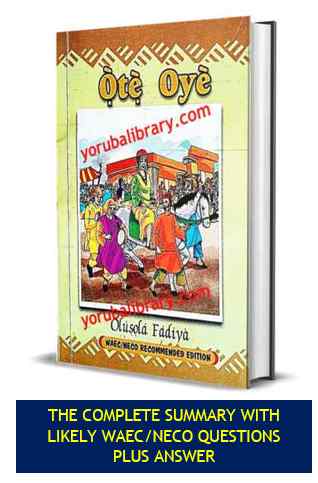 The scene focuses on three connected developments: the chiefs' attempt to announce their candidate, the people's interruption of the ceremony, and Balógun Akíngbọlá's public challenge to the integrity of the process. As evidence of secret oaths and bribery which was developed in previous scenes begins to circulate, the conflict becomes a question of public accountability rather than simply a disagreement among palace officials.
For students preparing for WAEC and NECO Yoruba Literature, this scene is especially important for understanding the play's treatment of political corruption, traditional authority, truth, public participation and the consequences of attempting to manipulate the succession to the throne.
Detailed Summary of Act 5, Scene 3
The public square becomes the centre of the conflict. The scene takes place in the public square, a setting that carries considerable dramatic significance. Earlier developments in the play involved private discussions, secret agreements and attempts to influence the kingmakers. Now, the struggle has entered a space where the community can witness and respond to the decisions being made.
The chiefs attempt to announce their chosen candidate
The chiefs attempt to formally announce the candidate they have selected. Their action represents an effort to move the succession process towards a conclusion and to present their preferred choice as an acceptable decision. However, the announcement does not proceed smoothly. The people interrupt the ceremony and resist the attempt to carry the process forward without resolving their concerns.
The interruption demonstrates that the succession crisis has not been settled simply because influential people have chosen a candidate. The authority to make or announce a decision does not automatically guarantee that the decision is legitimate, fair or acceptable to the community.
The people refuse to remain silent
The interruption of the ceremony represents a major change in the relationship between the people and the political authorities. Earlier in the play, rumours and suspicions spread among ordinary residents. Market women and young people increasingly showed their concern about the attempt to manipulate the succession. By this stage, public dissatisfaction has developed into direct resistance.
Balógun Akíngbọlá challenges the selection process
Balógun Akíngbọlá steps forward to challenge the integrity of the selection process publicly. His intervention is significant because he is not simply expressing personal dissatisfaction with the candidate. He is questioning the legitimacy of the procedure through which the candidate is being presented.
Evidence of secret oaths begins to circulate
Another important development is the circulation of evidence relating to the conspirators' secret oaths. These oaths were part of the arrangements through which the conspirators attempted to bind themselves to their plan and maintain secrecy. The emergence of information about these agreements undermines the secrecy on which the conspiracy depends. What was once concealed among a limited group of participants is now becoming a matter of public concern.
Allegations of bribery become public knowledge
Evidence of bribery also begins to circulate among the crowd. The expression owó àbẹ̀tẹ́lẹ̀ refers to a bribe or money offered improperly to influence a decision. Bribery is central to the larger conflict because the succession struggle has repeatedly shown how wealth and personal ambition can distort the judgement of those entrusted with choosing a king.
Respect for elders meets the demand for justice
One of the most significant ideas in the scene is the changing relationship between traditional respect for elders and the demand for justice. In Yoruba society, respect for elders and established institutions is an important social value. However, the scene presents a situation in which respect cannot simply be used to silence questions about wrongdoing.
The confrontation prepares the audience for the breaking point
Act 5, Scene 3 intensifies the conflict without resolving every issue immediately. The chiefs' attempt to announce their candidate is interrupted, Balógun questions the process, and information about secret oaths and bribery spreads through the crowd. These developments prepare the ground for the next scene, where the confrontation becomes even more intense. The conspirators can no longer rely on secrecy or assume that their preferred arrangement will be accepted without resistance.
The people of Ojúrí: Agents of public accountability
The people are important because they refuse to remain passive spectators. Their interruption of the announcement demonstrates that the succession crisis has become a public issue. Their collective response challenges the idea that the community must accept every decision made by influential figures. They insist, through their resistance, that the integrity of the succession process matters to the entire town.
Ariwoola: The candidate at the centre of the dispute
Ariwoola has been established in the wider play as the candidate preferred by the people. The attempt by the conspirators to impose their chosen candidate must therefore be understood against the existing disagreement over who should occupy the throne.
The public confrontation is not simply a contest between two individuals. It concerns the principles that should guide succession: legitimate procedure, the welfare of the town, and the relationship between the wishes of the people and the authority of the kingmakers.
Students should avoid claiming that this particular scene settles the succession completely. Its immediate function is to expose and challenge the process through which the chiefs are trying to advance their candidate.
Major Themes in Act 5, Scene 3
1) Public accountability
Public accountability is one of the strongest themes in this scene. The chiefs are expected to exercise their authority responsibly, but their attempt to announce a candidate is interrupted by people who question the legitimacy of the process.
The circulation of evidence concerning secret oaths and bribery makes accountability more urgent. Leaders cannot expect their conduct to remain beyond criticism merely because they hold respected positions.
2) Truth and the exposure of wrongdoing
The evidence of secret agreements and bribery begins to circulate in the public square. This marks an important stage in the movement from secrecy to exposure. The conspirators' plan depended partly on keeping their arrangement hidden. Once information reaches the crowd, however, their ability to control the narrative weakens.
3) Corruption and bribery
The expression owó àbẹ̀tẹ́lẹ̀ brings the issue of bribery directly into the confrontation. Money becomes a symbol of the improper influence that has damaged the succession process. Bribery is dangerous because it replaces public duty with private reward. When a decision-maker accepts money to favour a particular candidate, the interests of the community may be sacrificed to the interests of the person paying.
4) The courage to challenge wrongdoing
Balógun Akíngbọlá's public intervention illustrates the courage required to confront influential people when their actions are questionable. It is easier to criticise wrongdoing privately than to challenge it in front of the people responsible and their supporters. Balógun's role is therefore important because he brings the issue into the open.
Moral Lessons from Act 5, Scene 3
1. Authority must be exercised responsibly. Holding a title does not excuse dishonesty or the abuse of power.
2. Truth is essential to legitimate leadership. Decisions made through concealment and manipulation invite suspicion and resistance.
3. Bribery damages public trust. When money influences decisions that should be made responsibly, the whole community may suffer.
4. Courage is necessary to defend justice. Balógun Akíngbọlá demonstrates the importance of challenging a questionable process publicly.
5. Tradition should not be used as a cover for wrongdoing. Genuine respect for tradition requires respect for its legitimate principles.
CONNECT WITH US: