support@yorubalibrary.com
+2348073529208
As we step into this new phase of Eégún Aláré, the narrative shifts from individual touring to the grandest stage of all: the royal arena of the Aláàfin of Ọ̀yọ́. Having been officially summoned and honored with the prestigious title of Baálẹ̀ Arẹ̀kú-Eégún, Ọ̀jẹ́ládé arrives alongside his fellow master performer and co-contender, Dúdúyemí, to vie for the ultimate leadership of the masquerade arts. This chapter talks about the breathtaking majesty of traditional Yorùbá performance arts, where poetry, incantations, ancestral invocation, and spiritual heritage merge into a high-stakes cultural contest. 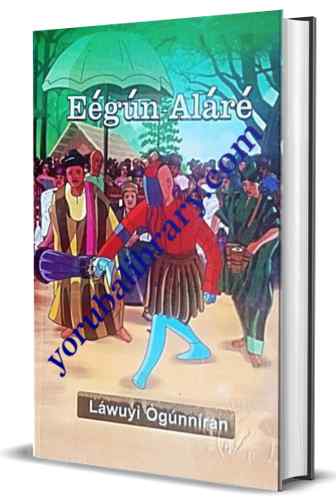 The atmosphere at the Aláàfin's court is electric, drawing crowds of spectators, chiefs, and dignitaries from neighboring towns who have gathered to witness the clash of titans. Before any physical dancing or magical display can commence, strict traditional protocols demand absolute reverence to the spiritual hierarchy. Both performers must pay homage to their lineage, invoke the spirits of their founding fathers, and demonstrate their mastery of ancient incantations (ọ̀fọ̀ and ìbà). For students preparing for WAEC and NECO, this section serves as an exceptional deep dive into the poetic richness, linguistic depth, and philosophical foundations of classical Yorùbá literature.
Furthermore, this segment talks about the interplay between stage performance and personal history. Through rhythmic chants, poetic dialogues with their wives (such as Àǹséétù), and public tests of historical knowledge, the performers bare their origins, celebrate their forebears, and prove their legitimacy. The text brilliantly demonstrates how art is inextricably linked to genealogy, memory, and spiritual accountability.
The Grand Arrival and Royal Expectations at the Aláàfin's Court
1) The Royal Summons:
Ọ̀jẹ́ládé and Dúdúyemí arrive at the palace grounds under the direct gaze of the Aláàfin and a massive gathering of nobles and townspeople.
2) The Contest for Supremacy:
Both artists are tasked with proving their supremacy to claim the coveted leadership position of Baálẹ̀ Arẹ̀kú-Eégún, with the King demanding absolute transparency and skill.
3) Setting the Stage for Oaths:
Before the performance begins, the king emphasizes that true authority belongs only to the one whose mastery of chants, incantations, and stagecraft proves authentic and unassailable.
Invoking Ancestral Lineage and Spiritual Homage (Ìbà)
a) Paying Respects to the Source:
Ọ̀jẹ́ládé takes center stage to render his ancestral homage (ìbà), kneeling to invoke the spirits of ancient witches, wizards, elders, and his direct forebears.
b) Honoring Ọ̀jẹ́ Lárìnnáká:
In emotional and poetic verses, he pays glowing tribute to his late father, Ọ̀jẹ́ Lárìnnáká, acknowledging his mother Ìyádùnnúní, and praising the legacy of his family's magical and theatrical craft.
c) Spiritual Safeguards:
The invocation highlights the traditional belief that no performance can succeed without establishing a spiritual link to the ancestors, local deities (such as Ẹsù Láàlú), and the elemental forces of nature.
Poetic Dialogues, Chants, and Public Spectacle
1) Dúdúyemí's Turn and Interaction:
Dúdúyemí steps forward, engaging the audience and his wife in rhythmic poetic exchanges that test wit, memory, and historical knowledge of various towns like Ìjárá and Ìrèsà.
2) The Audience's Admiration:
The crowd responds with thunderous applause (àtẹ́wọ́), showering the performers with praise, gifts, and deep admiration as the artistic duel unfolds.
3) Weaving History into Performance:
The chants recount historical lineages, migratory exploits, and praises of ancient warriors, transforming the arena into a museum of cultural heritage.
Character Dynamics and Analysis
Ọ̀jẹ́ládé:
Poised, deeply respectful of his roots, and supremely confident in his inherited magical and artistic repertoire.
Dúdúyemí:
A formidable rival whose lyrical dexterity and command of ancestral praise poetry (oríkì) match Ọ̀jẹ́ládé's brilliance, creating a tense and thrilling competition.
The Aláàfin of Ọ̀yọ́:
The ultimate arbiter of culture, maintaining high standards and ensuring that artistic succession is determined by merit and spiritual authenticity.
Major Themes
1) The Primacy of Ancestral Heritage:
The central idea that an artist's power and success flow directly from honoring their forebears and maintaining spiritual margins.
2)Art as Historical Preservation:
How performance poetry (oríkì and ìbà) preserves genealogy, migration
history, and identity across generations.
What Happened Next?
With both master performers delivering breathtaking invocations and dazzling the royal court, how will the Aláàfin judge between them? What hidden secrets or trials will emerge as the contest reaches its absolute peak?
BROWSE OTHER AVAILABLE WAEC/NECO TEXTS
Eégún Aláré

Òtè Òye
CONNECT WITH US: