support@yorubalibrary.com
+2348073529208
In Yoruba spirituality, no blessing comes without structure. Every Orisha embodies not only power but also expectation. Devotion is not merely expressed through praise, offerings, or festivals—it is measured through conduct. This is especially true in the case of Orisha Oko, a deity whose domain is based on cultivation, order, and moral discipline.
Unlike deities associated with sudden force or dramatic intervention, Orisha Oko operates through consistency. His influence is steady, patient, and tied to the rhythms of the land. Crops do not grow overnight. Harvest does not come without effort. And in the same way, his favor is not granted through momentary acts but through sustained conformity with his principles. These principles are expressed through taboos—rules that define what must not be done.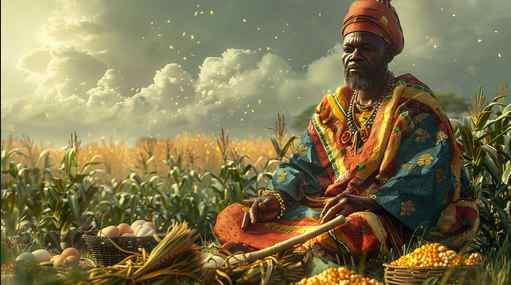 Taboos, within the Yoruba framework, are not arbitrary prohibitions. They are boundaries that protect balance. They exist to maintain unity between humans, nature, and the spiritual forces that govern both. In the context of Orisha Oko, these taboos are particularly significant because they directly affect survival. A violation is not just a spiritual offense; it can manifest in poor harvests, infertile land, or social instability.
To understand these taboos, one must first understand the nature of the space Orisha Oko governs. The farm is not just a workplace—it is a sacred environment. It is a place where human effort meets divine approval, where the invisible determines the visible. Every action taken on the land carries weight, and every decision contributes to the outcome. The taboos serve as a guide, ensuring that this delicate relationship is not disrupted.
Another important dimension is the connection between morality and productivity. In many traditions, success is linked to skill or luck. In the worldview surrounding Orisha Oko, success is also linked to character. Honesty, discipline, and respect are not just social virtues—they are agricultural necessities. A dishonest farmer may work hard, but without moral decency, the expected results may not come. This belief gives taboos a dual function: they regulate both behavior and outcome.
At the same time, taboos are not enforced through constant supervision. Their power lies in belief and internal discipline. Individuals are expected to regulate themselves, guided by the understanding that the land responds to their actions. This creates a system where responsibility is internalized rather than imposed.
Modern perspectives may view taboos as restrictive, but within their original context, they function as a framework for sustainability. They ensure that resources are used responsibly, that relationships remain stable, and that spiritual balance is maintained. They are, in essence, a form of governance—one that operates without written laws but with strong cultural enforcement.
⚡ Wait...Do You Really Know the True Secrets of the Orishas?
Why was Sango called Jakuta before he was crowned Oba Koso? What hidden power lies in Ogun Onire’s original pact? And why is Obatala worshipped as the Apex Deity?
Stop guessing! True Orisha wisdom goes far beyond surface-level stories. Check out the secrets behind Sango, Ogun, Obatala, Osun, Esu, and Oro with our comprehensive e-book series. Inside each structured guide, you'll discover:
🎁The Masterclass e-Books Available at token! Claim Your Copy Today
Prohibition of Dishonesty in Agricultural Practices
One of the most fundamental taboos associated with Orisha Oko is dishonesty, especially in matters related to farming. This includes lying about harvest yields, stealing crops, manipulating communal resources, or deceiving others in agricultural agreements.
In traditional belief, the land itself responds to truth. A dishonest act is not hidden—it is absorbed into the environment and showed in the outcome. Crops may fail, yields may decrease, or unforeseen challenges may arise. This creates a system where honesty is not just a moral choice but a practical necessity. The emphasis on truth also extends to communal relationships. Trust is essential in shared farming systems, and any act that undermines it is seen as a violation not only of social norms but of spiritual order.
Sexual Abstinence Before and During Certain Rituals
Sexual activity is sometimes restricted before specific farming rituals or during critical agricultural periods. This taboo is linked to the concept of focus and discipline.
Farming, under Orisha Oko, requires a certain mental balance. Sexual activity, which is associated with pleasure and distraction, may be seen as interfering with this during key moments. Abstinence, therefore, is not a rejection of sexuality but a temporary measure to maintain concentration and ritual purity.
Prohibition of Violence and Bloodshed on the Farm
The farm, as a space governed by Orisha Oko, is expected to remain peaceful. Acts of violence, including unnecessary bloodshed, are considered serious violations.
This taboo cements the idea that the land should not be stained with conflict. Violence introduces disorder, which can disrupt the balance required for successful cultivation. Even disputes are expected to be resolved outside the farm, preserving its sanctity.
Restriction on Entering the Farm in an Impure State
Certain conditions are considered incompatible with the sacred nature of the farm. These may include entering the farm after engaging in activities deemed spiritually disruptive or during periods of impurity.
The concept of impurity here is not moral but ritualistic. It relates to states that are believed to interfere with the harmony of the environment. By restricting access during such times, the system seeks to maintain consistency and balance.
Prohibition of Disrespect Toward the Land
The land is not treated as an object but as a living entity. Acts of disrespect—such as careless destruction, wastefulness, or neglect—are considered violations of Orisha Oko’s domain.
Farmers are expected to approach the land with humility and care. This includes proper use of tools, responsible management of resources, and avoidance of unnecessary damage.
🌿Unluck Natural Healing with Your Backyard Plants!
Ever wondered what secrets your local leafs and plants have for lifelong health? Do you know what they can cure? Stop relying solely on pills which are chemicals!
With years of experience, we’ve compiled authentic knowledge into 3 masterclass e-books:
Restriction on Unauthorized Ritual Practices
Not everyone is permitted to perform certain rituals associated with Orisha Oko. Specific rites require knowledge, experience, and sometimes initiation.
Unauthorized attempts to perform these rituals are considered taboo. This restriction protects the integrity of the practices and prevents misuse of sacred knowledge.
Avoidance of Conflict and Negative Speech on the Farm
Words are believed to carry power. Speaking negatively, engaging in arguments, or expressing harmful intentions on the farm is discouraged.
Such behavior is seen as introducing negative energy into the environment, which can affect the outcome of the harvest. Maintaining a calm and respectful atmosphere is therefore essential.
Conclusion
The general taboos of Orisha Oko are not random restrictions. They form a coherent system designed to maintain balance between humans, the land, and the spiritual forces that govern both.
CONNECT WITH US: