support@yorubalibrary.com
+2348073529208
Orisha Oko is not a deity of spectacle. He does not announce himself with lightning or warfare. Instead, his influence is seen in the steady growth of crops, the fertility of the soil, and the moral structure of agrarian life. His presence is subtle but foundational. Without him, there is no food. Without food, there is no society. And without society, the relevance of all other powers becomes uncertain. This is what makes Orisha Oko not just another deity in the Yoruba pantheon, but a central pillar of existence itself.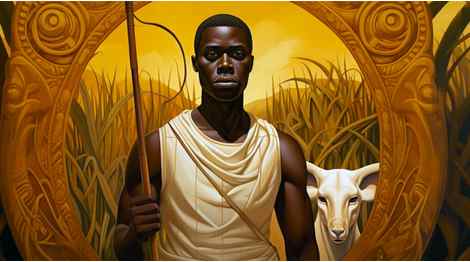 In traditional Yoruba thought, agriculture is not merely an economic activity—it is an engagement between humans and the earth. The soil is alive, responsive, and spiritually charged. Planting is not just labor; it is a covenant. Harvest is not just reward; it is a form of divine approval. Orisha Oko stands at the center of this exchange, ensuring that human effort conforms with natural order. His domain goes beyond crops; it includes justice, honesty, and moral discipline within rural life.
This is where Orisha Oko begins to separate himself from many other Orishas. While others govern specific elements or human activities, Orisha Oko governs a process that touches every human being daily—eating. His influence is constant, repetitive, and lies in survival. Unlike war or storms, which occur at intervals, agriculture is continuous. It demands patience, discipline, and trust in unseen processes. These qualities define the character of Orisha Oko himself.
Another dimension of his uniqueness lies in his association with moral integrity. In many oral traditions, Orisha Oko is seen as a witness to truth, especially in matters concerning honesty and fairness. Farmers who lie, cheat, or act unjustly are believed to lose his favor, resulting in poor harvests or infertile land. In this sense, Orisha Oko is not only a provider but also a moral enforcer. He represents the idea that prosperity must be earned through righteousness, not manipulation.
Within the broader Yoruba cosmology, the relationship between humans, nature, and the divine is interconnected. No Orisha operates in isolation. Olodumare is the ultimate source of all power, and each Orisha functions as an intermediary channeling specific aspects of that divine authority. Orisha Oko’s channel is the earth itself—specifically cultivated land. This distinguishes him from deities of wild nature or untamed forces. His domain is organized, human-influenced nature, where effort and divine blessing meet.
It is also important to understand that Orisha Oko’s quiet nature does not imply weakness. In fact, his power is one of the most feared. A failed harvest can destroy entire communities. Famine can destabilize kingdoms. Hunger can break even the strongest individuals. In this sense, Orisha Oko has a form of power that is less visible but far more enduring. He does not need to strike; he simply withholds.
In the league of Yoruba Orishas, each deity contributes to the balance of existence. Some protect, some guide, some punish, and some transform. Orisha Oko sustains. He represents continuity, nourishment, and the ethical foundation of labor. His uniqueness lies not in dramatic acts, but in the quiet assurance that life can continue.
Understanding Orisha Oko is essential for anyone seeking a complete picture of Yoruba spirituality. Without acknowledging his role, one risks overlooking the very foundation upon which all other spiritual expressions stand. For in the end, before humans seek power, justice, or enlightenment—they must first eat.
⚡ Wait...Do You Really Know the True Secrets of the Orishas?
Why was Sango called Jakuta before he was crowned Oba Koso? What hidden power lies in Ogun Onire’s original pact? And why is Obatala worshipped as the Apex Deity?
Stop guessing! True Orisha wisdom goes far beyond surface-level stories. Check out the secrets behind Sango, Ogun, Obatala, Osun, Esu, and Oro with our comprehensive e-book series. Inside each structured guide, you'll discover:
🎁The Masterclass e-Books Available at token! Claim Your Copy Today
The Agricultural Authority of Orisha Oko
Orisha Oko is primarily known as the deity of agriculture, but this description only scratches the surface. His authority extends over land fertility, crop productivity, seasonal cycles, and the overall success of farming activities. In traditional Yoruba society, where agriculture formed the backbone of survival, this role placed him among the most essential spiritual forces.
Farmers did not approach the land casually. Before planting, rituals were often performed to seek Orisha Oko’s blessing. These rituals were acts of respect, acknowledging that human effort alone could not guarantee success. Rain might fall, seeds might be planted, but without Olodumare's blessings, the outcome remained uncertain. Orisha Oko ensured that the natural elements worked in unity with human labor.
His influence also extends to land purity. It is believed that land used for immoral activities or stained by injustice becomes spiritually unproductive. In such cases, no amount of effort can restore its fertility without proper spiritual cleansing. This solidifies the idea that agriculture, under Orisha Oko, is not purely physical—it is as well ethical.
Orisha Oko as a Custodian of Truth and Justice
One of the most distinctive aspects of Orisha Oko is his association with truth. Unlike deities whose justice is immediate and forceful, Orisha Oko’s justice is gradual but unavoidable, just like how Orisha Obatala operates. He is often invoked in matters where honesty is in question, particularly in disputes related to land, farming agreements, or communal resources.
In some traditions, individuals swear by Orisha Oko to prove their innocence. The belief is that falsehood under his witness will eventually lead to consequences—often manifested through failed harvests or personal misfortune. This makes him not just a provider, but a silent judge whose verdict unfolds over time.
The Essence of Fertility and Productivity
Fertility, under Orisha Oko, goes beyond the soil. While he is directly associated with crop growth, his influence extends to human reproduction and general prosperity. Fertile land and fertile families are seen as parallel expressions of divine favor.
This connection highlights the Yoruba understanding of life as an interconnected system. Just as the earth must be nourished to produce crops, human relationships must be nurtured to produce unity and continuity. Orisha Oko depicts this cycle of growth, where productivity is both physical and social.
🌿Unluck Natural Healing with Your Backyard Plants!
Ever wondered what secrets your local leafs and plants have for lifelong health? Do you know what they can cure? Stop relying solely on pills which are chemicals!
With years of experience, we’ve compiled authentic knowledge into 3 masterclass e-books:
Relationship with Other Orishas in the Pantheon
Orisha Oko does not operate in isolation. His role interacts with other Orishas in meaningful ways. For example, Orisha Ogun provides the tools used in farming—cutlasses, hoes, and other implements. Without Ogun, agriculture would lack the means of execution. Meanwhile, Sango influences weather patterns, particularly storms that can either nourish or destroy crops.
Osun contributes water, which is essential for irrigation and plant growth. These interactions show that while Orisha Oko governs agriculture, he depends on a network of other forces to fulfill his role.
Rituals, Worship, and Devotion
Worship of Orisha Oko is typically grounded in simplicity and sincerity. Unlike some Orishas that require elaborate ceremonies, his rituals often shows the humility of farming life. Offerings may include farm produce, yams, maize, and other crops—a sign of the very blessings he provides.
Festivals dedicated to him are usually tied to planting or harvest seasons. These events serve both spiritual and social purposes, bringing communities together to give thanks and seek continued favor. During such times, songs, prayers, and traditional rites cements the bond between humans, land, and the divine.
The Unique Position of Orisha Oko Among Yoruba Deities
What truly sets Orisha Oko apart is the combination of sustenance and morality within his domain. Many Orishas govern power, transformation, or protection, but Orisha Oko governs continuity. He ensures that life does not just exist, but continues in a stable and orderly manner.
His quiet nature makes him less visible in popular narratives, yet his importance cannot be overstated. He represents the idea that the most essential forces in life are often the least dramatic. Food, truth, and steady growth may not contains immediate attention, but they are the foundation upon which everything else depends.
Conclusion
Orisha Oko comprises a form of power that is both subtle and absolute. He does not compete with other Orishas for attention, yet his role touches every aspect of human survival. Through agriculture, he feeds the body. Through justice, he guides behavior. Through fertility, he sustains continuity.
CONNECT WITH US: