support@yorubalibrary.com
+2348073529208
In the rhythm of Yoruba traditional life, festivals are not random celebrations. They are carefully structured moments where the visible and invisible worlds meet, where memory is renewed, and where society pauses to acknowledge the forces that sustain it. Among these sacred observances, the festival dedicated to Orisha Oko stands apart in both tone and purpose. It is not loud in the way of thunder festivals, nor dramatic in the way of warrior rites. Instead, it comprises a grounded presence—firm and steady.
To understand the Orisha Oko Festival is to understand a worldview where survival is paramount. Farming, in Yoruba society, is not simply labor; it is a relationship between humans and the land, governed by discipline and truth. The festival becomes the point where this relationship is publicly acknowledged. It is where the community says, in collective voice, that the harvest is not just the result of effort, but of oneness between human conduct and divine order.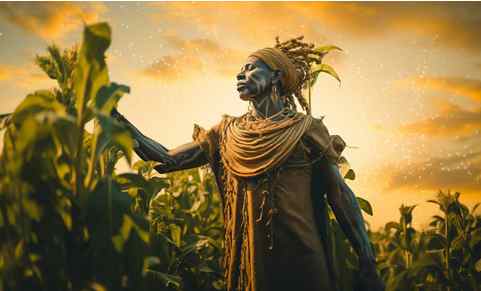 Unlike festivals that revolve around spectacle, this one is built around meaning. Every action, every offering, and every performance carries weight. The planting season, the waiting period, and the eventual harvest all find their culmination in this gathering. It is a moment of accounting—what was done right, what was done wrong, and what must be corrected moving forward.
There is also a quiet authority in the way this festival operates. It does not demand attention through force; it commands respect through necessity. Without successful agriculture, there is no food. Without food, there is no society. This truth shapes the entire structure of the festival. It is less about celebration for its own sake and more about recognition of dependence—on the land, on moral conduct, and on divine favor.
In many Yoruba communities, particularly in agrarian regions such as Ekiti State and Ondo State, the Orisha Oko Festival remains one of the most traditionally celebrated events of the year. It is not ordinary preserved as tradition; it is actively lived. Farmers, elders, and families all participate in ways that reflect their roles within society. The festival becomes a point where generations meet—where knowledge is passed down.
Another important dimension of this festival is its timing. It is often go alongside with agricultural cycles, particularly the harvest period. This timing shows its connection to real life. A good harvest strengthens the spirit of the festival, while a poor one introduces a tone of correction.
The uniqueness of the Orisha Oko Festival lies in this balance between celebration and responsibility. It allows joy, but it demands accountability. It encourages gratitude, but it also enforces discipline. It is a festival that feeds both the body and the conscience.
To fully grasp its significance, one must move beyond the idea of festivals as entertainment. This is not an event designed for spectacle alone. It is a system—a structured expression of belief, culture, and social order.
⚡ Wait...Do You Really Know the True Secrets of the Orishas?
Why was Sango called Jakuta before he was crowned Oba Koso? What hidden power lies in Ogun Onire’s original pact? And why is Obatala worshipped as the Apex Deity?
Stop guessing! True Orisha wisdom goes far beyond surface-level stories. Check out the secrets behind Sango, Ogun, Obatala, Osun, Esu, and Oro with our comprehensive e-book series. Inside each structured guide, you'll discover:
🎁The Masterclass e-Books Available at token! Claim Your Copy Today
Insight: The Meaning Behind the Festival
At its core, the Orisha Oko Festival is about acknowledgment. It recognizes that agriculture is not a guaranteed outcome but a process influenced by both human effort and spiritual connection. This insight shapes every aspect of the festival.
The deity at the center of the celebration, Orisha Oko, is not only a provider of fertile land but also a guardian of truth. This dual role gives the festival a much wider meaning. It is not enough to plant and harvest; one must also live rightly. The condition of the land is seen as a result of the condition of the people.
This belief creates a system where success is interpreted as approval, and failure as a signal for reflection. It encourages individuals and communities to examine their actions, not just their methods. The festival, therefore, becomes a time of both gratitude and self-assessment.
Performance: Rituals, Expressions, and Cultural Display
The performance aspect of the Orisha Oko Festival is subtle but powerful. It is not defined by excessive display but by meaningful actions that carry has weight.
Ritual offerings are central to the festival. These often include farm produce such as yam, maize, and other crops. These offerings are not random—they represent the very things that the deity has helped to produce. By returning a portion of the harvest, the community expresses gratitude and acknowledges the source of its sustenance.
Music and chants play an important role in creating atmosphere. Traditional songs are performed, often praising the virtues of Orisha Oko and recounting the importance of agriculture. These songs serve as both entertainment and education, passing down knowledge.
Dance, though present, is typically grounded and measured. It depicts the nature of the deity—steady, controlled, and connected to the earth. Unlike festivals associated with more dynamic Orishas such as Sango, where movement can be intense and dramatic, the dances here emphasize balance and rhythm. The involvement of community leaders, including elders and sometimes the Ọba, adds another layer of performance. Their participation is not merely ceremonial; it legitimizes the rituals and connects the people to their ancestral heritage.
🌿Unluck Natural Healing with Your Backyard Plants!
Ever wondered what secrets your local leafs and plants have for lifelong health? Do you know what they can cure? Stop relying solely on pills which are chemicals!
With years of experience, we’ve compiled authentic knowledge into 3 masterclass e-books:
Uniqueness: What Sets the Orisha Oko Festival Apart
What makes the Orisha Oko Festival unique is its focus on necessity rather than spectacle. Many festivals celebrate power, victory, or transformation. This one celebrates sustenance—the ability to live, eat, and continue.
Its quiet nature is one of its defining features. It does not rely on dramatic displays to assert its importance. Instead, its significance is understood through its impact on daily life. The food on the table, the stability of the community, and the continuity of generations all point back to the principles it represents.
Another unique aspect is its strong connection to morality. While many festivals include elements of gratitude and celebration, few tie success so directly to ethical behavior. In the context of Orisha Oko, a good harvest is not just a result of hard work—it shows right living.
The festival also stands out for its integration of time and cycle. It marks not just an event, but a transition. It signals the end of one phase and the beginning of another. This cyclical understanding of life cements the idea that actions have consequences, and that each season carries lessons for the next.
Social Impact: Strengthening Community Through Ritual
The Orisha Oko Festival plays a crucial role in maintaining social cohesion. It brings people together in a structured environment where shared values are showcased.
Thefestival also serves as a teaching moment. Younger members of the community observe and participate, learning not only the rituals but also the values behind them. This transmission of knowledge ensures continuity. In this way, the festival functions as both a cultural and social institution.
Conclusion:
The Orisha Oko Festival is a reflection of a society that understands the importance of balance—between effort and blessing, between celebration and responsibility, and between individual success and collective well-being.
CONNECT WITH US: