support@yorubalibrary.com
+2348073529208
In Yoruba spirituality, objects are never ordinary. What may appear as a simple tool or ornament in most times has multiple meaning that connect the physical world to spiritual realities. Among such objects is the sacred staff associated with Orisha Oko, otherwise known as Opa Orisha Oko. At first glance, may seem modest, but in truth represents authority, discipline, fertility, and moral order.
The staff is not merely an accessory of a deity; it is an extension of presence. In the case of Orisha Oko, whose domain centers on cultivated land, truth, and the ethical conduct of agrarian life, the staff becomes a visual and ritual expression of his power. It stands upright, yet elevated, bridging the soil and the sky—much like the role he plays in connecting human labor with divine approval.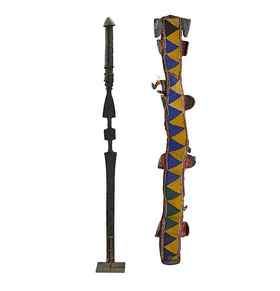 Unlike the weapons of deities such as Ogun or the thunder tools associated with Sango, the staff of Orisha Oko is not designed for destruction or display of force. Its power lies in stability and control. It represents a different kind of strength—the strength to maintain order, to guide, and to ensure that life continues in balance.
In agrarian societies, a staff is often linked to guidance and oversight. It can mark boundaries, support movement, and announces leadership. When placed within the context of Orisha Oko, these functions take on spiritual meaning. The staff becomes a marker of cultivated space, distinguishing land that is ordered and productive from land that is wild and untamed. It clearly shows the transition from chaos to structure, from potential to realization.
There is also a moral dimension to the staff. As a deity associated with truth and justice, Orisha Oko is believed to oversee not only the productivity of the land but also the integrity of those who work it. The staff, in this sense, functions as a silent witness. It represents the idea that actions are observed, that honesty matters, and that consequences follow behavior. It is not a weapon of punishment, but a reminder of accountability.
In many traditional settings, sacred staffs are handled with care and respect. They are not treated as ordinary objects but as carriers of presence. Ritual specialists, priests, or community elders may use them during ceremonies, not to command attention, but to channel authority. When the staff is present, it signals that something beyond the ordinary is taking place.
The simplicity of the staff is part of its power. It does not rely on elaborate decoration to convey meaning. Its form—straight, grounded, and upright—depicts the very principles it represents. It is a sign that communicates through form rather than excess, through function rather than ornament.
⚡ Wait...Do You Really Know the True Secrets of the Orishas?
Why was Sango called Jakuta before he was crowned Oba Koso? What hidden power lies in Ogun Onire’s original pact? And why is Obatala worshipped as the Apex Deity?
Stop guessing! True Orisha wisdom goes far beyond surface-level stories. Check out the secrets behind Sango, Ogun, Obatala, Osun, Esu, and Oro with our comprehensive e-book series. Inside each structured guide, you'll discover:
🎁The Masterclass e-Books Available at token! Claim Your Copy Today
The Staff as a Symbol of Agricultural Authority
At its most direct level, the staff represents Orisha Oko’s authority over cultivated land. Agriculture, within Yoruba society, is a structured activity that requires discipline, timing, and knowledge. The staff embodies this structure.
When a farmer enters the field, the act is not random. It follows a pattern—clearing, planting, tending, and harvesting. The staff mirrors this sense of order. It stands as a reminder that the land responds to careful management, not careless action. Under the watch of Orisha Oko, the staff becomes a pillar of this disciplined approach.
It also represents ownership and responsibility. Just as a staff can mark territory, it signifies the boundaries within which a farmer operates. These boundaries are not only physical but also moral. They define what is acceptable and what is not, cementing the idea that agriculture is governed by both practical and ethical rules.
A Staff of Truth: Moral Oversight and Accountability
One of the less visible but important aspects of the staff is its connection to truth. Orisha Oko is often associated with honesty, particularly in matters related to land and communal resources. The staff, in this context, serves as a sign of moral oversight.
In traditional belief, actions carried out on the land are not hidden. The deity is aware of how individuals conduct themselves—whether they are fair in their dealings, whether they respect communal agreements, and whether they uphold the values expected of them. The staff represents this awareness.
It does not act in the way a weapon does. It does not strike or force compliance. Instead, it stands as a constant presence, reminding individuals that their actions have consequences. This form of authority is subtle but powerful, as it encourages self-regulation rather than external enforcement.
Ritual Use and Sacred Presence
The sacred staff is not confined to just ordinary meaning; it also plays a role in ritual practice. During festivals, ceremonies, and agricultural rites, it may be used to represent the presence of Orisha Oko.
In such settings, the staff is often treated with reverence. It may be placed in specific locations, held by ritual leaders, or incorporated into ceremonial actions. Its presence signals that the event is not purely social but spiritual.
🌿Unluck Natural Healing with Your Backyard Plants!
Ever wondered what secrets your local leafs and plants have for lifelong health? Do you know what they can cure? Stop relying solely on pills which are chemicals!
With years of experience, we’ve compiled authentic knowledge into 3 masterclass e-books:
Comparison with Other Sacred Objects in Yoruba Tradition
To fully appreciate the uniqueness of Orisha Oko’s staff, it is helpful to compare it with the elements of other Orishas. The tools of Ogun, for example, are associated with cutting, forging, and transformation. They show a force that shapes and alters the world through direct action.
Similarly, the symbols linked to Sango emphasize power, intensity, and sudden impact. They represent a force that commands attention and can change conditions rapidly. By contrast, the staff of Orisha Oko represents continuity rather than change, stability rather than intensity. It is not about altering the world in dramatic ways but about maintaining it in a state of balance.
This distinction highlights the diversity within the Yoruba pantheon. Each Orisha comprises a different aspect of existence, and their symbols showing these differences.
The Staff as a Marker of Order and Civilization
Beyond its immediate associations, the staff can also be seen as a broader symbol of civilization. It represents the shift from a life governed by unpredictability to one structured by knowledge and discipline.
In this sense, the staff stands at the boundary between the wild and the cultivated. It marks the space where human effort has brought order to nature. Under the guidance of Orisha Oko, this order is not imposed recklessly but conforms with natural rhythms.
Conclusion
The sacred staff of Orisha Oko is a powerful example of how meaning can be carried in simple forms. It does not rely on spectacle or complexity to convey its significance. Instead, it communicates through presence and function.
CONNECT WITH US: