support@yorubalibrary.com
+2348073529208
The story of Sàngó is never complete without mentioning the three women whose lives became woven into his history: Òyá, Ọbà, and Òṣun.
Their names appear in oríkì, ritual chants, folktales, shrine narratives, and community memories across Yorùbá land. Each woman contributed something distinct to Sàngó’s identity — from strength, to loyalty, to emotional presence, to spiritual partnership.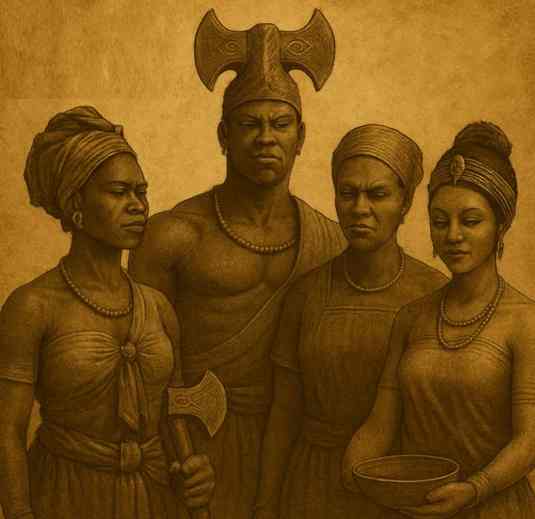
Many people know the popular tales, but very few understand how Yorùbá communities actually interpret the relationships. Yorùbá tradition does not view these women as ordinary partners; instead, each connection carries lessons, symbols, and moral insights about human behaviour, leadership, companionship, and spiritual alignment.
Sàngó and Òyá — Strength Meeting Strength
Among Sàngó’s companions, Òyá is the most closely tied to his public power. Their union is remembered as a meeting of two forces that amplified each other.
1. Òyá as Sàngó’s Partner in Power
Òyá is associated with strong winds, rapid movement, and sudden change. Sàngó carries thunder and controlled fire. Together, they represent powerful natural forces that must be handled with balance.
2. She Witnessed His Rise
In traditions from Oyo to Koso, Òyá is described as standing with Sàngó during decisive moments of his life — battles, rulership challenges, accusations, and his eventual departure from earthly life.
3. Guardian of the Edun Ara
Some oral accounts say Òyá was the keeper of Sàngó’s thunderstones. When he needed his symbolic weapons, Òyá was the one who knew their hiding place.
4. Fierce Loyalty
Òyá’s loyalty is praised as almost unmatched. She followed Sàngó through hardship and refused to abandon him during conflict. In Yorùbá view, Sàngó and Òyá represent a partnership built on courage and action — two people who understood each other’s strength.
⚡ Wait...Do You Really Know the True Secrets of the Orishas?
Why was Sango called Jakuta before he was crowned Oba Koso? What hidden power lies in Ogun Onire’s original pact? And why is Obatala worshipped as the Apex Deity?
Stop guessing! True Orisha wisdom goes far beyond surface-level stories. Check out the secrets behind Sango, Ogun, Obatala, Osun, Esu, and Oro with our comprehensive e-book series. Inside each structured guide, you'll discover:
🎁The Masterclass e-Books Available at token! Claim Your Copy Today
Sàngó and Òṣun — Calmness, Beauty, Intelligence and Comfort
Òṣun represents the softer part of Sàngó’s life — emotional support, mental calmness, wisdom, and presence.
1. Òṣun as the Soothing Voice
Where Sàngó’s temper ran high, Òṣun’s words were known to bring calmness. Her presence often softened the tension that came with kingship and authority.
2. Òṣun and Social Harmony
In some narratives, when disputes arose in Sàngó’s household or palace, Òṣun was the one who could speak gently and reduce conflict. Her wisdom made her invaluable to Sàngó.
3. Guardian of Beauty and Soft Strength
Unlike Òyá whose strength is outward, Òṣun’s strength is internal — persuasion, charm, understanding, and emotional intelligence. These qualities complemented Sàngó’s fiery nature. Together, Sàngó and Òṣun depicts the harmony between firmness and gentleness.
Sàngó and Ọbà — Devotion and Misunderstood Sacrifice
Ọbà is often remembered through one of the most repeated stories in Yorùbá folklore — the tale of a misunderstood sacrifice. But beyond the popular narrative, Yorùbá elders describe Ọbà as possessing deep devotion, patience, and loyalty.
1. The Most Devoted Spouse
Ọbà’s loyalty to Sàngó is portrayed as absolute. She loved him deeply and sought ways to please him beyond ordinary expectations.
2. The Story that Became a Warning
The well-known incident of the ear-soup is often misunderstood. In Yoruba view, it is not a tale of foolishness; it is a tale of how extreme devotion can lead to unintended consequences. It serves as a moral lesson: love must walk with wisdom.
3. Ọbà and Emotional Suffering
Her departure after the incident symbolizes the emotional pain people face when they give too much of themselves without proper guidance.
4. Ọbà’s Place in Sàngó Worship
Though her story is filled with sorrow, Ọbà is not forgotten. Shrines and songs maintain her dignity and recognize her as a figure of steadfast love. Sàngó and Ọbà represent the human side of relationships — joy, sacrifice, mistakes, and the consequences that follow.
🌿Unluck Natural Healing with Your Backyard Plants!
Ever wondered what secrets your local leafs and plants have for lifelong health? Do you know what they can cure? Stop relying solely on pills which are chemicals!
With years of experience, we’ve compiled authentic knowledge into 3 masterclass e-books:
Understanding the Three Together
1. Not a Competition
Yorùbá tradition does not portray these women as rivals fighting for position. Instead, each relationship shows a different aspect of human connection:
• Òyá — strength and partnership
• Òṣun — emotional wisdom and social harmony
• Ọbà — commitment and devotion
2. Symbol of Human Complexity
A king is not one-dimensional. Sàngó’s connections with these women reveal:
• His need for courage (Òyá)
• His need for comfort and wisdom (Òṣun)
• His need for loyalty (Ọbà)
These qualities are essential for anyone in leadership.
Conclusion
The relationship between Sàngó, Òyá, Ọbà and Òṣun is not just a story of a king and three women. It is a reflection of human life — strength, calmness, loyalty, sacrifice, and the complexities that shape relationships.
CONNECT WITH US: