support@yorubalibrary.com
+2348073529208
In many Yoruba communities, the boundary between the living and the dead is not seen as a permanent separation. Instead, it is understood as a passage between two interconnected worlds—Ayé (the visible world) and Òrun (the invisible realm of the ancestors). Communication between these worlds is not ordinary; it is real, structured, and protected through ritual, sound, and performance. One of the most powerful mediums of this communication is oral literature, where spoken words carry spiritual authority, cultural memory, and identity.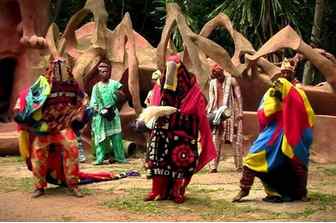 Among these forms of oral expression, È̩ṣà-Pípè, also known as Iwì-Kíké, stands as a unique and performance tied to the Egúngún tradition—the veneration of ancestral spirits. This is not merely poetry or chant in the ordinary sense. It is a ritualized vocal performance that transforms human speech into something believed to be beyond human. When performed correctly, È̩ṣà-Pípè does not sound like a person speaking; it sounds like a force emerging from the unseen. This transformation is intentional and based in belief systems that treat the ancestors as active participants in community life.
È̩ṣà-Pípè is preserved within lineages that are directly connected to the Egúngún cult. These are families and groups who carry the responsibility of maintaining ancestral rituals across generations. Within this structure, roles are clearly defined, knowledge is guarded, and performance is disciplined. The chants, rhythms, and vocal techniques are not improvised casually; they are learned, practiced, and passed down under strict cultural guidance. This makes È̩ṣà-Pípè not just an art form, but a form of inherited duty.
At the center of this tradition is the understanding that the ancestors are not silent. They speak through mediums, and rituals—and È̩ṣà-Pípè is one of their recognized voices. During festivals or sacred gatherings, when the masquerade appears, it is not treated as a costume or entertainment. It is approached with reverence, caution, and awareness that what is present represents ancestral authority. The chants that accompany such appearances are therefore not decorative; they are functional, spiritual, and binding.
Another important aspect of È̩ṣà-Pípè is its role in showcasing identity. In a time where many cultural practices face erosion, traditions like this serve as anchors. They tells communities of their origin, their lineage, and their responsibilities to both past and future generations. Through È̩ṣà-Pípè, history is not written—it is spoken, heard, and remembered.
What makes this form even more striking is the way it engages the senses. The altered voice, the rhythm of the drums, the call-and-response structure—all combine to create an atmosphere that is both intense and meaningful. It is not something that can be fully understood from description alone; it must be practically experienced within its proper setting to grasp its full weight.
As we move into a closer look at È̩ṣà-Pípè, it becomes clear that this is not just about sound. It is about authority, transformation, restriction, and continuity. It is about who can speak, how they speak, and what their voice represents within the larger Yoruba worldview.
⚡ Wait...Do You Really Know the True Secrets of the Orishas?
Why was Sango called Jakuta before he was crowned Oba Koso? What hidden power lies in Ogun Onire’s original pact? And why is Obatala worshipped as the Apex Deity?
Stop guessing! True Orisha wisdom goes far beyond surface-level stories. Check out the secrets behind Sango, Ogun, Obatala, Osun, Esu, and Oro with our comprehensive e-book series. Inside each structured guide, you'll discover:
🎁The Masterclass e-Books Available at token! Claim Your Copy Today
Understanding È̩ṣà-Pípè and Iwì-Kíké
È̩ṣà-Pípè and Iwì-Kíké refer to the same form of oral performance within the Egúngún tradition. The term “Iwì-Kíké” can be loosely understood as “heightened vocal expression,” pointing to the distinctive style in which it is delivered. È̩ṣà-Pípè, on the other hand, is the more commonly used name in performance contexts, especially during festivals and public displays.
This form of chant is performed by members of Egúngún lineages—both men and women. However, participation is not equal in all aspects. While both genders may contribute to the chanting and singing, there are specific vocal techniques and ritual roles that are restricted, especially when it comes to the transformed voice associated with ancestral presence.
È̩ṣà-Pípè is typically structured in verses, rich in praise, historical references, warnings, and acknowledgments of lineage. The language used is not casual; it has layers of meaning that may only be fully understood by those within the tradition. Each performance depicts the connection between the community and its ancestral roots.
The Role of the Ologbojo and the Sacred Space of Igbo Igbale
At the center of Egúngún worship is the Ologbojo, the recognized head and custodian of the tradition. His role is administrative, spiritual, and well respected. On Yoruba saying goes thus "Ologbojo ni Baba Egungun" The Ologbojo oversees rituals, maintains order among devotees, and ensures that practices like È̩ṣà-Pípè are carried out correctly.
One of the most important spaces under his care is the Igbo Igbale—the sacred grove where masquerades are prepared before appearing in public. This is not an ordinary location. It is a consecrated environment where transformation takes place. Costuming, spiritual preparation, and ritual activation of the masquerade all occur within this space.
È̩ṣà-Pípè often begins or is refined within this sacred setting before being brought into public performance. The chants, therefore, carry the weight of what has already been invoked in the grove. When they are heard outside, they are not new—they are extensions of what has already been established spiritually.
The Unique Vocal Transformation in Male Performance
One of the most striking features of È̩ṣà-Pípè is the deliberate alteration of the human voice. During performance, male chanters adopt a deep, distorted, almost animal-like tone. This is not done for dramatic effect alone; it serves a clear purpose—to signal that the voice being heard is no longer that of an ordinary human.
This transformation creates a psychological and spiritual shift in the audience. It marks the presence of the ancestral, reinforcing the belief that the masquerade has more than just a person in costume. The sound becomes a boundary marker between the ordinary and the sacred.
In Yoruba tradition, this specific vocal technique is restricted to men. Women, although active participants in other aspects of the chant, do not engage in this transformed voice. This restriction is part of a broader system of roles and taboos that govern Egúngún practices.
The Role of Bata Drums in È̩ṣà-Pípè Performance
No È̩ṣà-Pípè performance is complete without the presence of the Bàtá drum. The drum does not simply accompany the chant—it interacts with it. The rhythms mirror the tone, pace, and intensity of the vocal delivery, creating a synchronized performance that feels alive.
The Bàtá drum is known for its ability to “speak.” Skilled drummers can replicate the tonal patterns of Yoruba language, effectively communicating messages through rhythm. During È̩ṣà-Pípè, this creates a layered experience where both voice and drum contribute to meaning.
The verses of È̩ṣà-Pípè often follow the rhythm set by the drums, allowing for a dynamic exchange between chanter and percussionist. This relationship adds depth to the performance, making it both auditory and communicative.
🌿Unluck Natural Healing with Your Backyard Plants!
Ever wondered what secrets your local leafs and plants have for lifelong health? Do you know what they can cure? Stop relying solely on pills which are chemicals!
With years of experience, we’ve compiled authentic knowledge into 3 masterclass e-books:
Structure and Poetic Elements of È̩ṣà-Pípè
È̩ṣà-Pípè is typically composed in verses, with each line carrying specific intent. Some verses praise ancestors, others recount lineage history, while some serve as warnings or moral reminders. The language may include metaphors, proverbs, and coded expressions that require cultural knowledge to interpret.
The performance often follows a pattern where a lead chanter delivers a line, and others respond to it. This creates a communal rhythm that draws in both participants and observers.
Example of Practical Rendition of È̩ṣà-Pípè
Find below an example chant of Esap Pipe in Egungun worship:
O to, onibata mi,
Oju o ni o ti
Aso o ni ya meegun lori
Ayan agalu o gbe o
Ilu o ni ya mo o lowo
Nitori Ologbojo naa ni
Solo ogbin
Ti mo jo ran-in-rain-in lori labala
Mo togege redi eku
Oko Fadeke
Ike mi o jo t'Oya
Ka gbe mi f'Oya
Gannku eyin mi ko jo t'Orisa
Ka gbe mi f'Oosa l'Awe
Ike mi wa dike amuseye
Omo onike bolumo
Odonko baba wii lesa
In performance, the chant is delivered with intensity, accompanied by the steady and responsive beat of the Bàtá drum. The lead voice rises above the rhythm, shifting between controlled speech and the transformed ancestral tone. The chorus responds in unison, creating a layered sound that fills the space and commands attention.
Cultural Significance and Continuity
È̩ṣà-Pípè is more than a performance—it is core part in the realm of Yoruba oral literature. Through it, histories are preserved, identities stands, and spiritual beliefs are maintained. It serves as a bridge between generations, ensuring that knowledge is not lost but continuously renewed.
CONNECT WITH US: