support@yorubalibrary.com
+2348073529208
Act 4 marks a major turning point in Ọ̀tẹ̀ Oyè. The conspiracy involving Gbádàmọ́ṣí, Majasan, and other compromised kingmakers begins to collapse as information about their manipulation of the succession process becomes public. Their attempt to install a puppet king is undermined by the exposure of bribery, secret oaths, and the decision to bypass the guidance of Ifá.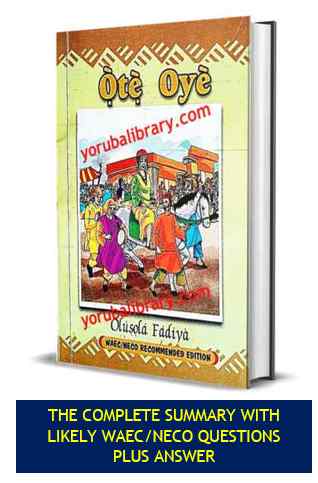 Across the four scenes, the conflict moves from secrecy towards public confrontation. Some of the conspirators become afraid of the consequences of their actions, while the people of Ojúrí increasingly demand accountability. Balógun Akíngbọlá remains an important defender of tradition and justice.
10 Theory Questions and Answers on Act 4
Question 1: Give a detailed account of the major events in Act 4 of Ọ̀tẹ̀ Oyè.
Answer:
Act 4 presents the exposure and weakening of the conspiracy to manipulate the succession to the throne of Ojúrí. The plotters had attempted to influence the selection process and install a puppet king who could serve their interests. However, their scheme begins to fail as the truth about their activities, including bribery and secret oaths, comes to light.
Question 2: What is the main conflict in Act 4?
Answer:
The main conflict is between the conspirators' desire to manipulate the succession and the demand that the selection of a new king should respect tradition, truth, and the welfare of the community.
On one side are the plotters, particularly Gbádàmọ́ṣí and Majasan, whose actions are connected with the attempt to control the succession. On the other side are those who oppose the manipulation, including Balógun Akíngbọlá and members of the community who demand a legitimate process.
Question 3: Explain how the conspiracy begins to collapse in Act 4.
Answer:
The conspiracy begins to collapse because the plotters can no longer keep their actions secret. Information about the manipulation of Ifá, the secret oaths, and the bribery starts to circulate beyond the private circle of the conspirators. Their chosen candidate also fails to secure genuine spiritual and communal support. This weakens the plan because a ruler cannot achieve lasting legitimacy simply through the wishes of a few powerful individuals.
Question 4: What is the significance of the attempted installation of an ọba-àfọwọ́dá in Act 4?
Answer:
An ọba-àfọwọ́dá is a puppet king—a ruler whose position or decisions are controlled by other people. In the play, the idea is significant because it reveals the conspirators' desire to possess political influence without necessarily exercising legitimate authority themselves.
Question 5: Explain the importance of Ifá in Act 4.
Answer:
Ifá is important because it represents divine guidance within the traditional process of selecting a ruler. Its place in the succession process indicates that kingship is not treated merely as a political prize to be distributed according to personal preference.
Get The Ultimate Ọ̀tẹ̀ Oyè Summary, and read at your convenient pace in English/Yoruba and Pass The Forthcoming Exam in Flying Colour. Download PDF Sample here
Question 6: Discuss the significance of bribery in Act 4.
Answer:
Bribery is a major cause of the crisis because it turns the selection of a ruler into an opportunity for personal gain. Instead of allowing the process to be guided by legitimate considerations, the conspirators use money to influence decisions and advance their preferred arrangement.
The emergence of information about owó àbẹ̀tẹ́lẹ̀—bribe money—weakens their position. What had been treated as a private means of securing support becomes a public indication that the process has been corrupted.
Question 7: What is the significance of the secret oaths taken by the conspirators?
Answer:
The secret oaths, referred to as ìbúra àṣírí, are intended to bind the conspirators together and discourage members from revealing their plans. They represent the secrecy and mutual obligations on which the conspiracy depends. However, the oaths also become a source of danger when the scheme begins to collapse. The conspirators can no longer rely on secrecy to protect themselves, and the existence of their agreement contributes to the exposure of their wrongdoing.
Question 8: Interpret the expression “A kì í fi Òrìṣà ṣẹ̀fẹ̀” in relation to Act 4.
Answer:
The expression means, in essence, “One must not mock or treat the deity with contempt.” It warns against behaving as though sacred powers and traditional obligations can be manipulated without consequences.
Question 9: How does the attitude of the people of Ojúrí contribute to the events of Act 4?
Answer:
The people of Ojúrí contribute to the conflict by refusing to remain passive while the succession process is surrounded by suspicion. As information about the conspiracy spreads, members of the community demand explanations and greater transparency.
Question 10: Discuss the theme of public accountability in Act 4.
Answer:
Public accountability is a central theme because the conspirators can no longer rely entirely on private agreements to protect their actions. As the information about bribery, secret oaths, and the manipulation of Ifá spreads, they face questions about their conduct.
The movement from secrecy towards public scrutiny is important. Decisions concerning the throne have consequences for the whole community, so the people have a legitimate interest in the integrity of the selection process.
Key Words and Expressions to Remember
The following terms and expressions are useful for understanding Act 4 and answering questions about its major conflicts, characters, and themes.
1. “Oyè tá a fi owó rà kò ní mu alaafia wa.”
Meaning: A title or throne bought with money will not bring peace.
2. “A kì í fi Òrìṣà ṣẹ̀fẹ̀.”
Meaning: One must not mock or treat a deity with contempt.
3. Ìfẹ́ ará ìlú
Meaning: The will, wishes, or interests of the people.
4. Ìtú-àṣírí gbangba
Meaning: The public exposure or revelation of a secret.
5. Ojukokoro
Meaning: Greed or excessive desire for personal gain.
6. Ẹ̀rí-ọkàn
Meaning: Conscience.
7. Ìfura
Meaning: Suspicion or distrust.
8. Ìṣọ̀kan
Meaning: Unity or togetherness.
CONNECT WITH US: