support@yorubalibrary.com
+2348073529208
Act 3 marks an important turning point in Ọ̀tẹ̀ Oyè. In Act 2, the audience sees political rivalry, selfish interests and the growing influence of money in the selection of a successor to the late Ọba Adéwúwo. In Act 3, these tensions develop into a deliberate conspiracy led by Gbádàmọ́ṣí and Majasan.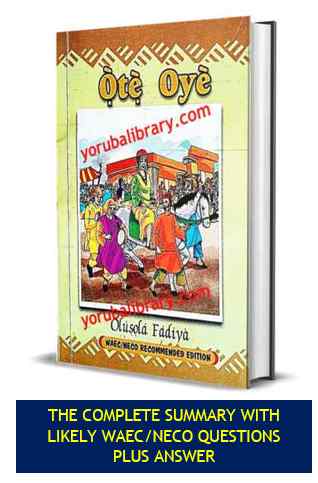 The conspirators want to influence the succession process and install a king who can serve their interests. Their plans threaten the traditional procedure represented by Ifá and undermine the wishes of the people, who prefer Ariwoola. As the conspiracy develops, the characters face problems of secrecy, distrust and fear of discovery.
10 Theory Questions and Answers of Act 3
Question 1: Give a detailed account of the events in Act 3 of Ọ̀tẹ̀ Oyè.
Answer:
Act 3 develops the conspiracy surrounding the succession to the throne of Ojúrí. The act begins with Gbádàmọ́ṣí and Majasan discussing their hidden plans to install a puppet king. Their intention is to influence the succession in a way that will allow them to maintain political power and pursue their private interests.
The conspiracy represents a direct challenge to the proper selection process. Instead of allowing the traditional procedures and Ifá's guidance to determine the succession, the conspirators intend to bypass or manipulate these safeguards. Their plans reveal that the struggle is no longer simply a disagreement about candidates; it has become an organized attempt to control the throne.
Question 2: Who are the two principal conspirators in Act 3, and what roles do they play?
Answer:
The two principal conspirators are Gbádàmọ́ṣí and Majasan. Gbádàmọ́ṣí is the main strategist behind the plot. He is ambitious and determined to influence the succession in a way that protects his interests. He helps shape the plan to install a puppet king and seeks to maintain control over the other participants. As pressure increases, he becomes more aggressive in trying to keep the conspiracy together.
Majasan is the other major participant. Although he joins the conspiracy, he becomes increasingly concerned about its dangers. His fear of exposure and public disgrace distinguishes him from Gbádàmọ́ṣí, who attempts to preserve the scheme through greater pressure and intimidation.
Question 3: Explain how rumours begin to threaten the conspiracy in Act 3.
Answer:
Rumours threaten the conspiracy because the plan depends on secrecy. Gbádàmọ́ṣí and Majasan want to manipulate the succession without attracting public resistance. However, as people begin to discuss suspicious developments, the conspirators lose their ability to control the information surrounding their activities.
Question 4: Discuss the role of the youth in Act 3.
Answer:
The youth play an important role as voices of public conscience. Their concern about the succession struggle shows that younger members of the community are unwilling to remain indifferent when the town's future is threatened.
They represent the demand for justice, accountability and a fair process. As rumours about the conspiracy spread, the youth become part of the wider public response to the possibility that powerful individuals are manipulating the throne.
Question 5: Explain the significance of the market women in Act 3.
Answer:
The market women represent the active participation of ordinary citizens in matters affecting the community. Their presence in the developing public response shows that the succession crisis has consequences beyond the palace and the circle of political elites.
Get The Ultimate Ọ̀tẹ̀ Oyè Summary, and read at your convenient pace in English/Yoruba and Pass The Forthcoming Exam in Flying Colour. Download PDF Sample here
Question 6: Discuss the theme of greed in Act 3.
Answer:
Greed is central to the conspiracy developed in Act 3. Gbádàmọ́ṣí and Majasan are not simply concerned with the qualities of a suitable successor; they want to influence who becomes king so that their own interests can be protected.
Their plan to install a puppet king reveals the extent to which ambition has displaced public responsibility. Rather than accept a process that may produce an independent ruler, they attempt to control the outcome.
Question 7: What does the expression “Rúkèrúdò” mean, and how is it relevant to Act 3?
Answer:
Rúkèrúdò refers to chaos, disorder or serious unrest. It is relevant to Act 3 because the conspiracy threatens the peace and unity of Ojúrí. By trying to manipulate the succession, the conspirators create a situation in which the people may reject the process and challenge those responsible for it.
The expression describes the danger that political wrongdoing can produce consequences beyond the individuals who planned it. A dishonest attempt to control the throne can divide the community, weaken trust in traditional institutions and provoke confrontation.
Question 8: How does Act 3 portray secrecy and fear?
Answer:
Secrecy and fear are closely connected in Act 3. The conspirators conceal their plans because they know that public knowledge could prevent them from achieving their objectives. The secret oaths are intended to protect the scheme, but they also place pressure on those involved. Each participant must remain silent, even as doubts and anxiety grow.
Question 9: Explain how dramatic irony is used in Act 3.
Answer:
Dramatic irony occurs when the audience knows or understands something that creates a contrast with the assumptions or expectations of characters in the drama. In Act 3, the audience is shown the conspirators' secret plans to influence the succession and install a puppet king. This knowledge makes their public positions and attempts to preserve the appearance of a legitimate process more suspicious.
Question 10: Explain how Act 3 prepares the audience for Act 4.
Answer:
Act 3 prepares the audience for Act 4 by moving the succession struggle from hidden plotting towards the possibility of public exposure. First, Gbádàmọ́ṣí and Majasan establish their plan to install a puppet king. This gives the conflict a clear direction and reveals the extent of their ambition.
Second, the use of secret oaths shows how the conspirators attempt to protect their scheme. However, their reliance on secrecy also creates anxiety and makes the group vulnerable if information becomes public.
Key Words and Expressions to Remember
This glossary covers the important names, concepts and expressions associated with all five scenes of Act 3.
1. Ọ̀tẹ̀
Meaning: Conspiracy, plotting or intrigue.
2. ọba-àfọwọ́dá
Meaning: A puppet king or a ruler installed to serve another person's interests.
3. Ifá
Meaning: The Yoruba divination tradition and its system of spiritual guidance.
4. Ìbúra àṣírí
Meaning: A secret oath or pledge of secrecy.
5. Rúkèrúdò
Meaning: Chaos, disorder or serious unrest.
6. Ojukokoro
Meaning: Greed or excessive desire for personal gain.
7. Ìfẹ́ ará ìlú
Meaning: The wishes or will of the people.
8. Ìfura
Meaning: Suspicion or distrust.
9. Ìtànkálẹ̀ ọ̀rọ̀
Meaning: The spread or circulation of information.
10. Ẹ̀rí-ọkàn
Meaning: Conscience.
CONNECT WITH US: