support@yorubalibrary.com
+2348073529208
The figure of Èsù in Yorùbá religion is complex, multi-dimensional, and in Yoruba cosmology. However, early European missionaries often misunderstood him, equating him with the Christian concept of the Devil or Islamic Shaitan. This misinterpretation was not simply a matter of semantics; it had lasting effects on how Yorùbá spiritual practice was perceived, recorded, and sometimes suppressed.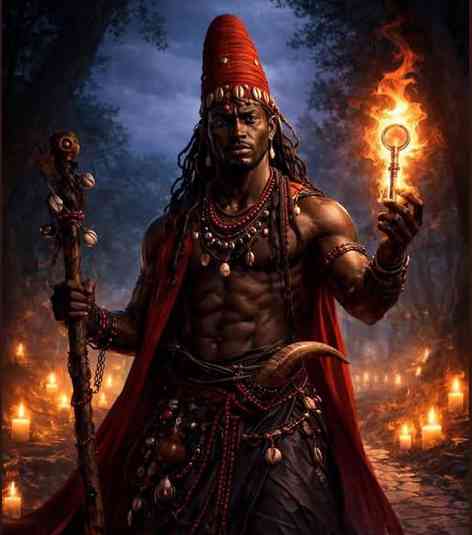 The misunderstanding stemmed from a combination of cultural unfamiliarity, linguistic inappropriation, and theological projection. Missionaries approached Yorùbá religion from a strictly monotheistic perspective, seeking analogues within their own religious framework. Because Èsù embodies paradox—he can bring both reward and punishment, blessing and misfortune—he was misread as evil incarnate. This historical lens obscured his actual role as messenger, enforcer, and guardian of moral balance.
Examining this history reveals the dynamics of cross-cultural mis-interpretation and the ways in which indigenous beliefs were filtered through colonial and missionary worldviews. It also helps clarify contemporary misconceptions and restores the integrity of Èsù’s role within Yorùbá cosmology.
Èsù in Indigenous Yoruba Cosmology
Before missionary contact, Èsù was understood as the mediator between humans and the divine. His responsibilities included:
1) Carrying offerings and prayers to other Òrìṣà
2) Regulating moral and ritual consequence
3) Guarding thresholds, crossroads, and gates
4) Enforcing Àṣẹ, the spiritual authority behind speech and action
Far from being malevolent, he was impartial, ensuring that both rewards and corrections were administered according to cosmic law. His duality—capable of doing both good and harm—was central to the balance of the universe.
Missionary Contact and Misinterpretation
1. Monotheistic Framework
Early Christian and Islamic missionaries approached Yorùbá religion through a monotheistic lens. Concepts of intermediary spirits who are neither wholly good nor wholly evil did not fit easily into Christian or Islamic paradigms.
• Èsù’s role as messenger was interpreted as trickery or deceit.
• His enforcement of consequence was equated with punishment from a malevolent source.
2. Linguistic Mis-alignment
Missionaries often translated Èsù as “Satan” or “Devil” in written texts. Yoruba words such as Aṣeburúkú Serere, highlighting his capacity for both good and harm, were simplified into labels of evil. The subtleties of oríkì (praise poetry) and ritual context were ignored.
3. Colonial Anxiety and Moral Framing
Missionaries were also concerned with social control. Framing Èsù as “devil” justified attempts to convert communities and suppress indigenous religious practices. Yorùbá rituals that involved palm oil, kola nut offerings, and shrine veneration were dismissed as occult or sinister.
⚡ Wait...Do You Really Know the True Secrets of the Orishas?
Why was Sango called Jakuta before he was crowned Oba Koso? What hidden power lies in Ogun Onire’s original pact? And why is Obatala worshipped as the Apex Deity?
Stop guessing! True Orisha wisdom goes far beyond surface-level stories. Check out the secrets behind Sango, Ogun, Obatala, Osun, Esu, and Oro with our comprehensive e-book series. Inside each structured guide, you'll discover:
🎁The Masterclass e-Books Available at token! Claim Your Copy Today
Consequences of Misinterpretation
1. Cultural Stigmatization
Many Yorùbá families internalized the notion that worshipping Èsù was morally dangerous. This led to secrecy around ritual practices and a gradual erosion of traditional knowledge in some communities.
2. Textual Distortion
Early ethnographic and religious records presented Èsù as an evil spirit, reinforcing misconceptions that persist in popular imagination today.
3. Religious Syncretism
The conflation of Èsù with the Devil influenced Afro-diasporic religions in the Americas, such as Santería and Candomblé, where colonial Christian frameworks reshaped perception of Exu/Èsù.
Restoring the Indigenous Understanding
Modern scholarship and Yorùbá practitioners emphasize:
• Èsù is neither evil nor malevolent by default.
• He ensures correlation between intention and outcome.
• His dual nature—rewarding good, correcting wrongdoing—is essential for spiritual and social balance.
• Misinterpretation occurred due to cultural projection, linguistic simplification, and colonial bias.
🌿Unluck Natural Healing with Your Backyard Plants!
Ever wondered what secrets your local leafs and plants have for lifelong health? Do you know what they can cure? Stop relying solely on pills which are chemicals!
With years of experience, we’ve compiled authentic knowledge into 3 masterclass e-books:
The Enduring Legacy
Despite centuries of misrepresentation, Èsù remains central in Yorùbá spiritual life. Contemporary practitioners:
a) Preserve ritual and shrine practices
b) Teach the true meaning of Àṣẹ and consequence
c) Celebrate his duality in oríkì and prayer
d) Educate younger generations to counter historical misinterpretation
Conclusion
Early missionaries misinterpreted Èsù as a devil or Shaitan due to their monotheistic framework, linguistic simplification, and colonial agenda. In truth, Èsù is a complex mediator, enforcer, and messenger who maintains cosmic and social balance.
CONNECT WITH US: