support@yorubalibrary.com
+2348073529208
Act 1 of Ọ̀tẹ̀ Oyè introduces the kingdom of Ojúrí following the death of Ọba Adéwúwo. Through the mourning rites at the palace, the actions of Balógun Akíngbọlá, the responsibilities of Sẹ̀gìlọlá and the arrival of the hunters, the opening Act establishes the political, cultural and traditional background of the play.
The Act also introduces important Yoruba expressions and customs associated with the death of a king. These details help readers understand the importance of tradition, community responsibility, respect for the deceased and the institutions of kingship.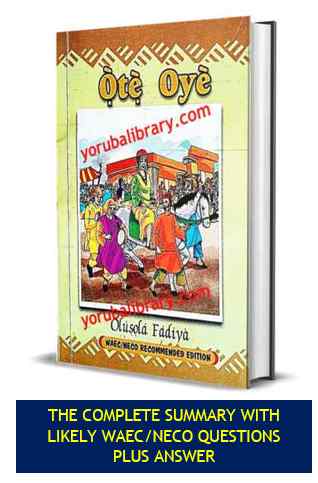 The following 10 theory questions cover Act 1, Scenes 1 and 2 together. Each question is followed by a suggested answer to help students prepare for WAEC and NECO Yoruba Literature examinations.
Section A: Ten Theory Questions and Answers on Act 1
Question 1: Give a detailed account of the events that take place in Act 1 of Ọ̀tẹ̀ Oyè.
Answer:
Act 1 opens at the palace of Ojúrí during a period of mourning following the death of Ọba Adéwúwo. The atmosphere is solemn, as the people and palace officials come to terms with the loss of their king. Balógun Akíngbọlá takes an important role in coordinating the people and encouraging them to remain united during this difficult period.
The death of the king is recognised through traditional expressions and mourning practices. The people acknowledge the inevitability of death and agree to observe the appropriate customs.
Question 2: Who was Ọba Adéwúwo, and what is the significance of his death in Act 1?
Answer:
Ọba Adéwúwo was the king of Ojúrí who had died before the opening events of the play. His death is the event that establishes the setting and atmosphere of Act 1.
His passing creates a period of mourning and requires the community to observe traditional rites. It also places the palace and the town in a period of transition because the throne has become vacant.
Question 3: Who is Balógun Akíngbọlá, and what role does he play in Act 1?
Answer:
Balógun Akíngbọlá is the military leader who helps coordinate the people of Ojúrí during the mourning period. His role is important because the death of a king can create uncertainty within a kingdom. By addressing the people and helping maintain order, he demonstrates leadership at a time when the community needs stability.
Question 4: Explain the meaning of the expression “Gbèsè ni ikú” as used in Act 1.
Answer:
“Gbèsè ni ikú” means that death is a debt that every human being must eventually pay. The expression communicates the idea that death is inevitable and no person can escape it forever. In the context of the death of Ọba Adéwúwo, the expression tells the people that even a king, despite his authority and position, is subject to mortality.
Question 5: What is meant by the Yoruba expression “Wàjà” in Act 1?
Answer:
In the context of the play, Wàjà is the traditional expression used for the death of a king. Its use demonstrates the cultural importance attached to the death of a monarch. The passing of a king is treated as a significant event requiring special recognition and appropriate rites.
Get The Ultimate Ọ̀tẹ̀ Oyè Summary, and read at your convenient pace in English/Yoruba and Pass The Forthcoming Exam in Flying Colour. Download PDF Sample here
Question 6: Who is Sẹ̀gìlọlá, and what are her responsibilities in Act 1, Scene 2?
Answer:
Sẹ̀gìlọlá is the senior wife in the palace of Ojúrí. In Act 1, Scene 2, she is responsible for helping manage the affairs of the royal household. She ensures that arrangements are made for visitors and that the palace is prepared for the traditional activities taking place after the king's death.
Question 7: Who are Àwọn Ọdẹ, and what role do they play in Act 1, Scene 2?
Answer:
Àwọn Ọdẹ are the hunters who arrive at the palace during the mourning activities. They are led by Àyánwùmí and perform the Ìrẹ̀mọ̀jẹ́ chant. Their role is not limited to hunting animals. In the context of the play, they are also associated with bravery, traditional knowledge, security and loyalty to the throne.
Question 8: Explain the relationship between Balógun Akíngbọlá and the hunters in Act 1, Scene 2.
Answer:
The relationship is based on mutual recognition, service and loyalty to the throne. Balógun Akíngbọlá acknowledges the hunters' contribution and thanks them for remaining loyal to the royal institution. His response shows that the hunters are not treated as insignificant visitors. Their bravery and traditional skills are valued by the leadership of Ojúrí.
Question 9: Discuss the theme of leadership in Act 1.
Answer:
Leadership is developed mainly through the roles of Balógun Akíngbọlá and Sẹ̀gìlọlá. Balógun helps coordinate the people and maintain order following the king's death. His conduct demonstrates the importance of providing direction when a community experiences loss and uncertainty.
Sẹ̀gìlọlá manages the royal household and ensures that preparations for visitors and traditional activities are carried out. Her work demonstrates the importance of organisation and responsibility within the palace.
Question 10: Examine the theme of unity and responsibility in Act 1.
Answer:
Unity and communal responsibility are shown through the way the people of Ojúrí respond to the death of Ọba Adéwúwo.
The community gathers to mourn the king and participates in traditional practices. Balógun Akíngbọlá helps coordinate the people, while the palace carries out its responsibilities and the hunters arrive to honour the deceased monarch.
Section B: Key Words and Expressions to Remember
The following glossary covers important names, cultural terms and expressions introduced in Act 1, with its scenes
1. Wàjà
Meaning: The traditional expression used in the play for the death of a king.
2. Ìjẹjẹ
Meaning: The seven-day mourning period identified in the book for the death of Ọba Adéwúwo.
3. “Gbèsè ni ikú”
Meaning: Death is a debt that everyone must eventually pay.
4. Ààfin
Meaning: Palace.
5. Balógun
Meaning: A military leader or war chief in the context of the play.
6. Ọba
Meaning: King.
7. Ìrẹ̀mọ̀jẹ́
Meaning: The traditional chant performed by the hunters in the context of Act 1.
8. Àṣà
Meaning: Culture, custom or tradition.
9. Ìṣọ̀fọ̀
Meaning: Mourning or the expression of grief.
10. Ìṣọ̀kan
Meaning: Unity or togetherness.
11. Oògùn
Meaning: Medicine or traditional medicinal preparations, depending on context.
12. Ìlú
Meaning: Town or community.
Conclusion
Act 1 of Ọ̀tẹ̀ Oyè introduces the death of Ọba Adéwúwo, the mourning customs of Ojúrí and the responsibilities of the people and palace officials during a period of transition.
CONNECT WITH US: