support@yorubalibrary.com
+2348073529208
Act 2 of Ọ̀tẹ̀ Oyè develops the political tension that follows the death of Ọba Adéwúwo. The question of who should succeed the late king becomes a concern not only for the palace and kingmakers but also for ordinary people in Ojúrí.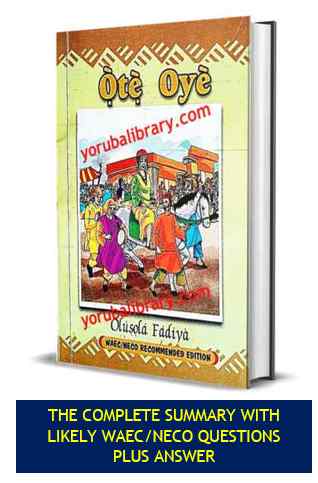 Across the four scenes, the play moves between public conversations and discussions among influential people. Ìyá Òjò and Òrófó represent the ordinary people who discuss and speculate about events surrounding the throne. The kingmakers, known as Afọbajẹ, face the responsibility of selecting a suitable successor, while individuals such as Gbádàmọ́ṣí and Majasan contribute to the growing atmosphere of suspicion and political competition. The questions below cover the four scenes of Act 2 together.
Part One: 10 Theory Questions and Answers
Question 1: Give a detailed account of the events in Act 2 of Ọ̀tẹ̀ Oyè.
Answer:
Act 2 examines the political and social tensions surrounding the selection of a successor to the late Ọba Adéwúwo. The act shows that the vacancy on the throne has created uncertainty and competition in Ojúrí.
In Scene 1, the setting moves away from the palace to a farm path, where Ìyá Òjò and Òrófó discuss the situation in the town. Their conversation reveals that ordinary people are interested in the succession question and are concerned about what the palace might be planning. Their discussion also introduces gossip, rumours and suspicion into the political atmosphere.
Scene 2 turns attention to the kingmakers and the candidates being considered for the throne. The kingmakers have the responsibility of choosing a suitable successor, but the discussions reveal differences of opinion and competing interests. Ariwoola is mentioned as a possible successor, while the role of Ifá highlights the importance of spiritual guidance in the traditional selection process.
Overall, Act 2 establishes the conflict between tradition and personal ambition, the people's wishes and elite interests, and responsible leadership and corruption. It prepares the ground for the conspiracy that develops later in the play.
Question 2: Who are Ìyá Òjò and Òrófó, and what is the significance of their conversation in Act 2?
Answer:
Ìyá Òjò and Òrófó are two women who appear in Scene 1 of Act 2. Their conversation takes place on a farm path rather than inside the palace.
Their discussion is significant because it shows that the succession struggle is not limited to the kingmakers and palace officials. Ordinary people are also watching events, discussing possible candidates and wondering whether the process will be peaceful.
Question 3: Explain the importance of the farm-path setting in Scene 1 of Act 2.
Answer:
The farm path is important because it creates a contrast between the palace and the ordinary community. While the palace is associated with formal authority and the selection of a king, the farm path provides a setting where ordinary people can discuss the political situation more informally.
Question 4: Who are the Afọbajẹ, and what is their responsibility in the succession process?
Answer:
The Afọbajẹ are the kingmakers responsible for participating in the selection of the next king. Their position gives them considerable influence over the future leadership of Ojúrí.
Question 5: What is the significance of Ifá in the selection of a new king in Act 2?
Answer:
Ifá represents spiritual guidance within the traditional succession process presented in the play. Its mention emphasizes that the selection of a king is not supposed to be determined solely by wealth, political influence or the wishes of powerful individuals.
Get The Ultimate Ọ̀tẹ̀ Oyè Summary, and read at your convenient pace in English/Yoruba and Pass The Forthcoming Exam in Flying Colour. Download PDF Sample here
Question 6: Who is Ariwoola, and why is he important in Act 2?
Answer:
Ariwoola is a potential successor to the throne of Ojúrí and the candidate identified in the book as the people's preferred choice.
His importance lies in what he represents in the succession struggle. The public's preference for him creates a contrast between the wishes of ordinary people and the interests of influential individuals who may want a different candidate.
Question 7: Explain the role of Gbádàmọ́ṣí in the succession struggle.
Answer:
Gbádàmọ́ṣí is an influential figure associated with political lobbying and the promotion of his preferred candidate. His activities contribute to the atmosphere of competition surrounding the throne.
Rather than treating the succession question only as a responsibility to the community, he is associated with the pursuit of a political arrangement that favours his own interests.
Question 8: What does Majasan contribute to the political atmosphere of Act 2?
Answer:
Majasan contributes to the atmosphere of suspicion and political uncertainty surrounding the selection of a new king. The study material associates him with critical scrutiny of the candidates and suspicion about possible plots.
His presence is important because the succession process is not taking place in an atmosphere of complete trust. The candidates and those supporting them are being viewed through the lens of political competition.
Question 9: Explain the meaning and significance of the title Ọ̀tẹ̀ Oyè.
Answer:
The title Ọ̀tẹ̀ Oyè refers to conspiracy, plotting or intrigue connected with the throne or a political title.
The two words are important because they identify the central conflict of the drama. Ọ̀tẹ̀ refers to plotting or conspiracy, while oyè refers to a title or position of authority, including the throne in the context of the play.
Question 10: Explain the expression “Oyè tá a fi owó rà kò ní mu alaafia wa.”
Answer:
The expression means, “A throne bought with money will not bring peace.” It is a warning against obtaining political authority through bribery or financial manipulation. A person may succeed in securing a position by paying others, but the method used to obtain that position can damage public trust and create conflict.
The expression is significant because it links the legitimacy of leadership with the process through which power is obtained. A ruler's success should not be measured only by whether he occupies the throne; the process must also command respect and contribute to the stability of the community.
Part Two: Key Words and Expressions to Remember
The following glossary covers the major people, institutions, ideas and expressions associated with all four scenes of Act 2.
1. Ọ̀tẹ̀
Meaning: Conspiracy, plotting or intrigue.
2. Oyè
Meaning: A title, rank or position of authority.
3. Afọbajẹ
Meaning: Kingmakers.
4. Ifá
Meaning: The Yoruba divination tradition and its associated system of spiritual guidance.
5. Ìfura
Meaning: Suspicion or distrust.
6. Ojukokoro
Meaning: Greed or excessive desire for personal gain.
7. Owó àbẹ̀tẹ́lẹ̀
Meaning: Bribe money or money offered to influence a decision.
8. Ìfẹ́ ará ìlú
Meaning: The wishes or will of the people.
9. Àṣà
Meaning: Culture or tradition.
Conclusion
The main purpose of Act 2 is to show how the search for a successor can become dangerous when people begin to place personal gain above the traditional process and the welfare of the community. It prepares the ground for the more direct conspiracy that follows in Act 3.
CONNECT WITH US: